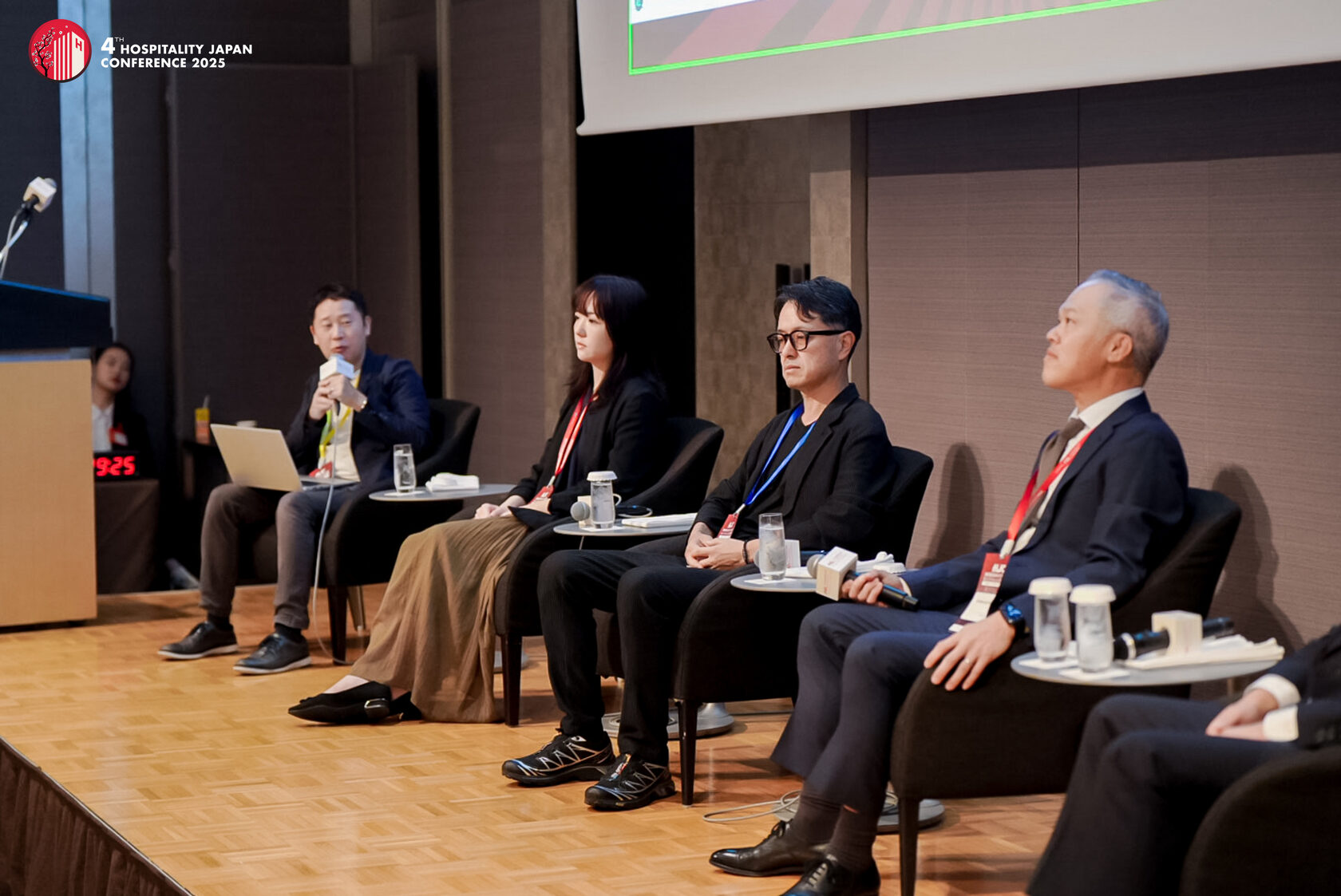
Tokyo, Japan — At the Hotel Investment Summit Japan #HISJ, industry leaders addressed how rising construction costs continue to challenge hotel development. Developers and owners are seeking smarter ways to protect investments and ensure sustainable returns. Speakers emphasized the importance of location and localization to unlock long-term value in Japan’s evolving hospitality landscape.
Investing in experience
Japan’s hotel market is redefining location strategy by blending cultural heritage with modern guest expectations. Panelists discussed how storytelling and site selection enhance both brand and experience.
Ryosuke Matsuo, General Manager of Corporate Planning and Hotel Division at Value Management Co., Ltd., said his team integrates history and place into the hospitality experience. “From the outside, the building may look quite old, but once you step inside, it’s fully renovated and looks beautiful,” he said. “If the hotel is located near a castle area—as in our case—we incorporate local attractions into the guest experience.”
Chika Kanamori, Executive Officer and Director of the Hotel Business Department at Mitsubishi Estate Co., Ltd., noted that hotels in cities must deliver a sense of place that feels authentic and memorable.
“People might think of Ginza as a sophisticated shopping district, but hotels can create their own identity within that environment,” she said. “Designing vibrant, interactive spaces—such as a series of themed bars where guests can move between experiences—helps cultivate engagement and local character.”
“In the bath area, for example, creating settings where guests can enjoy sake while listening to music and experiencing ambient lighting blends relaxation with entertainment,” she added. “Drawing from eras like the Showa period can also evoke nostalgia and connection, with restaurants serving traditional-style dishes or featuring small pub-like spaces that recall Japan’s classic snack bars.”
Localization
Beyond strategic locations, a successful hotel also calls for authentic localization that connects with surrounding communities.
Machiko Hamada, Executive Officer and General Manager of the Hotel Business Department at Kyushu Railway Company, said their dual role as a railway company and hotel operator strengthens local ties. “Because we are a railway company, we always have connections with the local governments as well as local communities as well,” she said. “That is the essence of our work.”
“We are involving local people to operate this project — we are leading this project together,” Hamada said. “I think the sense of togetherness with the local people is very important.”
“Creating an environment where the mixture of our hotel people as well as the local people, I think that’s the way to go to make sure that we have a vitalized area,” she added.
Panelists agreed that localization goes beyond design or branding—it’s about connecting people, history, and place. Matsuo emphasized balancing heritage with progress. “We need to think about conserving the historical establishments as well,” he said. “It’s not only about preserving the traditional things, but we are making sure that we connect the story with the modern world as well.”
Looking ahead
As Japan’s hospitality landscape continues to evolve, the 5th Hospitality Japan Conference #HJC2026 will once again gather industry leaders, investors, and innovators in Tokyo on October 7–8, 2026. The conference will continue to serve as a platform for forward-looking dialogue on the country’s hotel, tourism, and development landscape.
The next edition will deepen conversations on investment resilience, adaptive design, and the next phase of Japan’s tourism recovery. With renewed focus on regional revitalization, talent sustainability, and cross-sector collaboration, #HJC2026 will explore how the industry can strengthen its competitiveness while preserving Japan’s distinct sense of place.
Through the Hotel Investment Summit Japan, Hotel Design Summit Japan, and Hotel Revenue Summit Japan, Hospitality Asia will continue to lead the conversation on shaping the future of Japan’s hospitality—where creativity, cultural authenticity, and commercial performance intersect.
Stay tuned for more details on #HJC2026.
Learn more at: https://hospitality-japan.com/ or https://www.hospitalityjapanconference.com/
For inquiries, please contact: delegate@hospitality-asia.com
Investing in experience
Japan’s hotel market is redefining location strategy by blending cultural heritage with modern guest expectations. Panelists discussed how storytelling and site selection enhance both brand and experience.
Ryosuke Matsuo, General Manager of Corporate Planning and Hotel Division at Value Management Co., Ltd., said his team integrates history and place into the hospitality experience. “From the outside, the building may look quite old, but once you step inside, it’s fully renovated and looks beautiful,” he said. “If the hotel is located near a castle area—as in our case—we incorporate local attractions into the guest experience.”
Chika Kanamori, Executive Officer and Director of the Hotel Business Department at Mitsubishi Estate Co., Ltd., noted that hotels in cities must deliver a sense of place that feels authentic and memorable.
“People might think of Ginza as a sophisticated shopping district, but hotels can create their own identity within that environment,” she said. “Designing vibrant, interactive spaces—such as a series of themed bars where guests can move between experiences—helps cultivate engagement and local character.”
“In the bath area, for example, creating settings where guests can enjoy sake while listening to music and experiencing ambient lighting blends relaxation with entertainment,” she added. “Drawing from eras like the Showa period can also evoke nostalgia and connection, with restaurants serving traditional-style dishes or featuring small pub-like spaces that recall Japan’s classic snack bars.”
Localization
Beyond strategic locations, a successful hotel also calls for authentic localization that connects with surrounding communities.
Machiko Hamada, Executive Officer and General Manager of the Hotel Business Department at Kyushu Railway Company, said their dual role as a railway company and hotel operator strengthens local ties. “Because we are a railway company, we always have connections with the local governments as well as local communities as well,” she said. “That is the essence of our work.”
“We are involving local people to operate this project — we are leading this project together,” Hamada said. “I think the sense of togetherness with the local people is very important.”
“Creating an environment where the mixture of our hotel people as well as the local people, I think that’s the way to go to make sure that we have a vitalized area,” she added.
Panelists agreed that localization goes beyond design or branding—it’s about connecting people, history, and place. Matsuo emphasized balancing heritage with progress. “We need to think about conserving the historical establishments as well,” he said. “It’s not only about preserving the traditional things, but we are making sure that we connect the story with the modern world as well.”
Looking ahead
As Japan’s hospitality landscape continues to evolve, the 5th Hospitality Japan Conference #HJC2026 will once again gather industry leaders, investors, and innovators in Tokyo on October 7–8, 2026. The conference will continue to serve as a platform for forward-looking dialogue on the country’s hotel, tourism, and development landscape.
The next edition will deepen conversations on investment resilience, adaptive design, and the next phase of Japan’s tourism recovery. With renewed focus on regional revitalization, talent sustainability, and cross-sector collaboration, #HJC2026 will explore how the industry can strengthen its competitiveness while preserving Japan’s distinct sense of place.
Through the Hotel Investment Summit Japan, Hotel Design Summit Japan, and Hotel Revenue Summit Japan, Hospitality Asia will continue to lead the conversation on shaping the future of Japan’s hospitality—where creativity, cultural authenticity, and commercial performance intersect.
Stay tuned for more details on #HJC2026.
Learn more at: https://hospitality-japan.com/ or https://www.hospitalityjapanconference.com/
For inquiries, please contact: delegate@hospitality-asia.com